
The 70 Weeks of Daniel No. 2
A Brief History of the People of Israel (Continued)
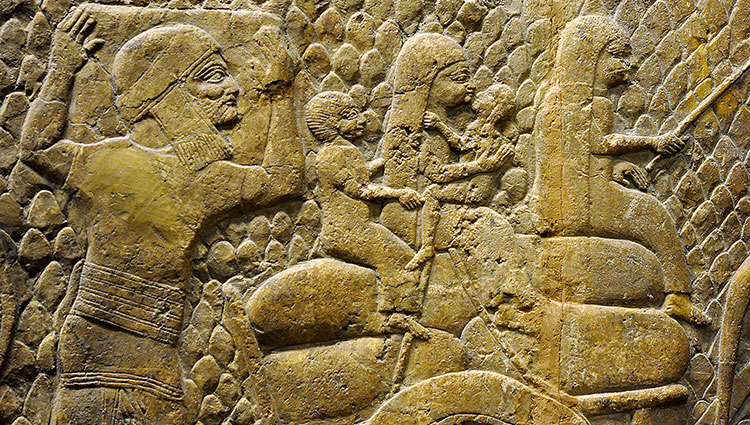
In Babylon
Once in captivity in Babylon, certain children of the Jewish people began to prosper in the court of the king of Babylon. These were Daniel and his companions. Daniel became greatly renowned throughout the kingdom of Babylon; his wisdom and understanding surpassed those of all the wise men, astrologers, and sorcerers of Babylon, to the point that Nebuchadnezzar appointed him chief over all the wise men of his kingdom (Daniel 2:48). Daniel had the gift of interpreting dreams and visions; he interpreted two of Nebuchadnezzar's (Daniel 2 and 4).
On one occasion, it came to pass that Belshazzar king of Babylon — the grandson of Nebuchadnezzar — gave a great feast to which he invited his lords. Excited by wine, the king commanded that the gold and silver vessels which his grandfather Nebuchadnezzar had taken from Jerusalem be brought to him, so that he and his lords and his wives might drink from them (Daniel 5:3). This was done. Immediately the fingers of a man's hand appeared and wrote a strange inscription upon the wall. Then the king's countenance changed and his knees smote together. The king called for the astrologers, soothsayers, and wise men of the empire to interpret the writing — but none of them was able to decipher it. Then Daniel was remembered and summoned at once. When he came before the king, he declared to the king all that must be said to him, and then recounted to him what his grandfather had done — in particular, when Nebuchadnezzar had sought to make himself equal with God and God had humbled him. After this discourse, Daniel gave the king the interpretation of the writing: numbered, numbered, weighed, and divided — which we may summarize as the fall of the kingdom of Babylon. And that very night, Belshazzar king of Babylon was slain, and Darius the Mede received the kingdom. Daniel 5:30–31.
This transition from the Babylonian to the Medo-Persian kingdom was most significant, for it marked the end of the 70 years of captivity; God had indeed prophesied this. Let us read Jeremiah 27:6–7, Jeremiah 25:11–12, and Jeremiah 29:10.
Jeremiah 27:6–7
6And now have I given all these lands into the hand of Nebuchadnezzar the king of Babylon, my servant; and the beasts of the field have I given him also to serve him. 7And all nations shall serve him, and his son, and his son's son, until the very time of his land come: and then many nations and great kings shall serve themselves of him.
Jeremiah 25:11–12
11And this whole land shall be a desolation, and an astonishment; and these nations shall serve the king of Babylon seventy years. 12And it shall come to pass, when seventy years are accomplished, that I will punish the king of Babylon, and that nation, saith the LORD, for their iniquity, and the land of the Chaldeans, and will make it perpetual desolations.
Jeremiah 29:10
For thus saith the LORD, That after seventy years be accomplished at Babylon I will visit you, and perform my good word toward you, in causing you to return to this place.
The 70 Weeks of Daniel
Beloved, having surveyed this historical background, let us now examine this prophecy of the 70 Weeks closely. In the very year when Darius became king, Daniel discovered through the Scriptures (Jeremiah 29:10) that seventy years must pass over the ruins of Jerusalem, after which the Lord would restore His people by bringing them back to their land. Daniel therefore turned to God to implore His grace and His mercy (Daniel 9:2–20). It was there that the prayer concerning the 70 years of captivity took on an altogether new dimension. Even before Daniel had finished praying, God sent the angel Gabriel to him with an answer. Gabriel made it known to him that the very moment he had opened his mouth to pray, an answer had been given — and that he, Gabriel, had come to announce that answer to him; and he bade Daniel pay close attention to the vision. Let us therefore discover, my beloved, what the messenger of God — Gabriel — had come to tell Daniel in response to his prayer concerning the 70 years of captivity. Without further delay, let us examine Daniel 9:24–27.
Daniel 9:24–27
24Seventy weeks are determined upon thy people and upon thy holy city, to finish the transgression, and to make an end of sins, and to make reconciliation for iniquity, and to bring in everlasting righteousness, and to seal up the vision and prophecy, and to anoint the most Holy. 25Know therefore and understand, that from the going forth of the commandment to restore and to build Jerusalem unto the Messiah the Prince shall be seven weeks, and threescore and two weeks: the street shall be built again, and the wall, even in troublous times. 26And after threescore and two weeks shall Messiah be cut off, but not for himself: and the people of the prince that shall come shall destroy the city and the sanctuary; and the end thereof shall be with a flood, and unto the end of the war desolations are determined. 27And he shall confirm the covenant with many for one week: and in the midst of the week he shall cause the sacrifice and the oblation to cease, and for the overspreading of abominations he shall make it desolate, even until the consummation, and that determined shall be poured upon the desolate.
Let us analyze these verses one by one, beginning with verse 24. Note, in passing, that verse 24 describes the purpose of this period of time — that is, of the 70 Weeks; verses 25 and 26 describe the phases of fulfillment of these 70 Weeks. These verses 25 and 26 show that the 70 Weeks are divided into three phases of fulfillment: a first phase of 7 weeks, a second of 62 weeks, and a last of 1 week (verse 27) — totaling 70 weeks. Verse 27, for its part, describes the 70th week — that is, the last. Let us return to verse 24.
Verse 24 : Seventy weeks are determined upon thy people and upon thy holy city, to finish the transgression, and to make an end of sins, and to make reconciliation for iniquity, and to bring in everlasting righteousness, and to seal up the vision and prophecy, and to anoint the most Holy.
Let us begin by noting that the people referred to here is the people of Israel, and the holy city is Jerusalem. These 70 Weeks therefore concern, first and foremost, the Jewish nation — Israel. The Bible thus informs us that 70 Weeks have been appointed over the nation of Israel and over the city of Jerusalem: to finish the transgression, to make an end of sins, to make reconciliation for iniquity, to bring in everlasting righteousness, to seal up the vision and prophecy, and to anoint the most Holy. Let us examine each of these points.
To finish the transgression means to put an end to the violation of the Word of God. To make an end of sins implies a total absence of defilement (sin). To make reconciliation for iniquity implies here a punishment to atone for wrongdoing (sin). To bring in everlasting righteousness speaks of the establishment of a justice that endures forever — this everlasting righteousness being the Kingdom of Jesus Christ, which is a Kingdom of righteousness. Let us read 2 Peter 3:13 and Isaiah 11:1, 3–5.
2 Peter 3:13
Nevertheless we, according to his promise, look for new heavens and a new earth, wherein dwelleth righteousness.
Isaiah 11:1, 3–5
1And there shall come forth a rod out of the stem of Jesse, and a Branch shall grow out of his roots: 3And shall make him of quick understanding in the fear of the LORD: and he shall not judge after the sight of his eyes, neither reprove after the hearing of his ears: 4But with righteousness shall he judge the poor, and reprove with equity for the meek of the earth: and he shall smite the earth with the rod of his mouth, and with the breath of his lips shall he slay the wicked. 5And righteousness shall be the girdle of his loins, and faithfulness the girdle of his reins.
To seal up the vision and prophecy denotes the fulfillment of all visions and prophecies. The vision and the prophecy cannot be sealed except at the coming of Jesus Christ, for He is the fulfillment of all visions and all prophets. One example: when Jesus came to earth the first time, it was the Law of Moses that was fulfilled (Matthew 5:17); at His second coming, it will be, for instance, the visions and prophecies of the book of Revelation that are fulfilled. What does it mean to anoint the most Holy? We all know that the most Holy is Jesus Christ. When the Bible speaks of anointing Jesus Christ, it simply means establishing Jesus Christ as King over the earth. Let us not forget that Jesus Christ is appointed to reign over all the earth during the Millennium — and this is, in fact, what the Bible is expressing here. Let us read Daniel 7:13–14 and Revelation 11:15.
Daniel 7:13–14
13I saw in the night visions, and, behold, one like the Son of man came with the clouds of heaven, and came to the Ancient of days, and they brought him near before him. 14And there was given him dominion, and glory, and a kingdom, that all people, nations, and languages, should serve him: his dominion is an everlasting dominion, which shall not pass away, and his kingdom that which shall not be destroyed.
Revelation 11:15
And the seventh angel sounded; and there were great voices in heaven, saying, The kingdoms of this world are become the kingdoms of our Lord, and of his Christ; and he shall reign for ever and ever.
The present earth is under human dominion, and when Jesus Christ returns, it will be to remove this corrupt human dominion and to establish His own Kingdom, in which He alone will be King. Many prophecies in the Bible show that Jesus Christ will be the King of all the earth in the place of the men who presently govern this world. Let us discover these prophecies together: Micah 5:1–3, Revelation 12:1–2, 5, and Psalm 2:7–9.
Micah 5:1–3
1But thou, Bethlehem Ephratah, though thou be little among the thousands of Judah, yet out of thee shall he come forth unto me that is to be ruler in Israel; whose goings forth have been from of old, from everlasting. 2Therefore will he give them up, until the time that she which travaileth hath brought forth: then the remnant of his brethren shall return unto the children of Israel. 3And he shall stand and feed in the strength of the LORD, in the majesty of the name of the LORD his God; and they shall abide: for now shall he be great unto the ends of the earth.
Revelation 12:1–2, 5
1And there appeared a great wonder in heaven; a woman clothed with the sun, and the moon under her feet, and upon her head a crown of twelve stars: 2And she being with child cried, travailing in birth, and pained to be delivered. 5And she brought forth a man child, who was to rule all nations with a rod of iron: and her child was caught up unto God, and to his throne.
Psalm 2:7–9
7I will declare the decree: the LORD hath said unto me, Thou art my Son; this day have I begotten thee. 8Ask of me, and I shall give thee the heathen for thine inheritance, and the uttermost parts of the earth for thy possession. 9Thou shalt break them with a rod of iron; thou shalt dash them in pieces like a potter's vessel.
You may also supplement this with Isaiah 11:1–10.
The age in which Jesus Christ will reign upon the earth is called the Millennium. Thus, when the Bible speaks of anointing the most Holy — who is Jesus Christ — it simply means establishing Jesus Christ as King over all the earth (as we have just seen above); and this will only be possible at the second coming of Jesus Christ.
We therefore understand that these 70 Weeks represent the total time or duration that God has appointed by His own sovereign authority to restore man — to deliver him from sin following the Fall — and also to establish His own Kingdom upon the whole earth. We thereby understand that Jesus Christ will return only at the end of the 70th Week.
Let us now examine the phases of fulfillment of these 70 Weeks so that we may know in which week we presently find ourselves. Note also that one (1) week corresponds to 7 years — you will discover this throughout the course of this teaching.
Verse 25 : Know therefore and understand, that from the going forth of the commandment to restore and to build Jerusalem unto the Messiah the Prince shall be seven weeks, and threescore and two weeks: the street shall be built again, and the wall, even in troublous times.
What is the Bible teaching us here? It teaches us that from the time the commandment went forth to restore and rebuild Jerusalem until the Messiah, the Prince, there are in all 7 weeks and 62 weeks — that is, 69 weeks. Note that the rebuilding referred to here is the one that took place after the Babylonians had destroyed the entire city of Jerusalem. Simply recall the various phases of deportation we studied above, or read the biblical passages that follow for a fuller understanding: Jeremiah 25:9, Jeremiah 52:12–13, Ezra 1:2–3, and the book of Nehemiah. The Messiah or the Prince is Jesus Christ. In brief, this verse 25 teaches us this: from the time the command to rebuild the city of Jerusalem was issued until the first coming of Jesus Christ upon earth — in order to die for our sins — 69 weeks (7 weeks and 62 weeks) out of the 70 appointed weeks have elapsed; therefore, only one (1) week remains — the 70th week.
Beloved, allow me to enter somewhat further into the details of this section. Verse 25 informs us that from the announcement of the rebuilding of Jerusalem until the first coming of Jesus Christ, there are 7 weeks and 62 weeks — 69 weeks in total. As mentioned above, one (1) week here corresponds to 7 years (you will discover this further along in this teaching); this therefore means that 7 weeks amount to a total of 49 years (7 weeks × 7 years) and 62 weeks to a duration of 434 years (62 weeks × 7 years). Now, the Bible informs us in John 2:20 that it took 46 years to rebuild the Temple after the Babylonian exile; moreover, this reconstruction was carried out with more or less interruption (Ezra 4:23–24). What does this imply? It implies that the rebuilding of the walls of Jerusalem and of the house of God after the exile took place during the 7 weeks — that is, over the course of 49 years; and that it then took 62 weeks — that is, 434 years from the rebuilding of Jerusalem — before the first coming of Jesus Christ, namely His death on the cross, His resurrection, and His ascension to God.
Verse 26 : And after threescore and two weeks shall Messiah be cut off, but not for himself: and the people of the prince that shall come shall destroy the city and the sanctuary; and the end thereof shall be with a flood, and unto the end of the war desolations are determined.
The cutting off of the Messiah (Jesus Christ) after the 62 weeks (434 years) corresponds here to the Death, the Resurrection, and the Ascension of Jesus Christ to the Father, as I have just noted above. The people of the prince who destroys the city and the sanctuary represent the Romans, who destroyed once again the city of Jerusalem and the second Temple after the death of Jesus Christ — more precisely in the year AD 70. Jesus Christ Himself had spoken of this destruction of the city of Jerusalem and the Temple before His death. Let us turn to Luke 19:41–46 and Mark 13:1–2.
Luke 19:41–46
41And when he was come near, he beheld the city, and wept over it, 42Saying, If thou hadst known, even thou, at least in this thy day, the things which belong unto thy peace! but now they are hid from thine eyes. 43For the days shall come upon thee, that thine enemies shall cast a trench about thee, and compass thee round, and keep thee in on every side, 44And shall lay thee even with the ground, and thy children within thee; and they shall not leave in thee one stone upon another; because thou knewest not the time of thy visitation. 45And he went into the temple, and began to cast out them that sold therein, and them that bought; 46Saying unto them, It is written, My house is the house of prayer: but ye have made it a den of thieves.
Mark 13:1–2
1And as he went out of the temple, one of his disciples saith unto him, Master, see what manner of stones and what buildings are here! 2And Jesus answering said unto him, Seest thou these great buildings? there shall not be left one stone upon another, that shall not be thrown down.
You will observe once again with me that of the 70 appointed weeks, 69 weeks (7 weeks and 62 weeks) have already been fulfilled — that only one week remains, the 70th — and that it is at the end of this last week that Jesus Christ will return. Are we still far from this last week? I leave you to answer that.
Before examining the last week, let us draw a brief summary of what we have seen. We have seen in this teaching that the 70 Weeks appointed by God represent the necessary duration that God has set to remove the defilements of this world — in short, to restore humanity and to establish His own Kingdom. We have said that the establishment of the Kingdom of God will only be possible at the second coming of Jesus Christ. We have also seen that these 70 Weeks have been divided into three phases of fulfillment: the first phase of 7 weeks, the second of 62 weeks, and the last of one (1) week — one week being equal to 7 years. Of the 70 appointed weeks, 69 weeks (7 weeks and 62 weeks) have been fulfilled and have elapsed; only one week remains — the last week, the 70th — which is to say, 7 years.
Beloved, there is one thing you should know: between the end of the 69th week and the beginning of the 70th week, there is, as it were, a pause in the fulfillment of these 70 Weeks. This pause represents none other than the last days — the last days being that period of time stretching from the birth of the Church on the Day of Pentecost to the Rapture of the Church. According to the text of Daniel 9:27, these last days will extend until the last week — the week in which the return of Jesus Christ, and therefore the Rapture of the Church, will take place.
Verse 27 : And he shall confirm the covenant with many for one week: and in the midst of the week he shall cause the sacrifice and the oblation to cease, and for the overspreading of abominations he shall make it desolate, even until the consummation, and that determined shall be poured upon the desolate.
In the concluding part of this teaching, we will examine closely this last week of 7 years.
May the Lord bless you!